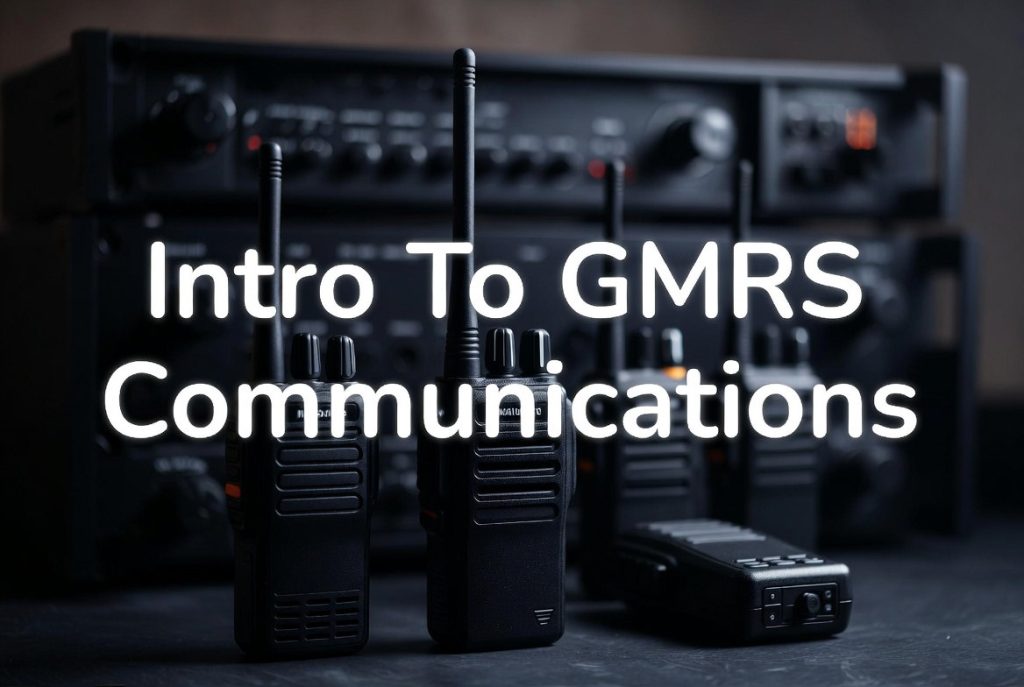
Introduction to GMRS Communications
When Hurricane Helene tore through the Southeast, communication networks failed across wide areas. Roads flooded, power went out, and cell towers went dark. For many people caught in the chaos, handheld radios became a lifeline.
During the storm, I lost contact with my brother and his wife in the mountains of Tennessee. Reports of widespread destruction were coming in, and I had to call a neighboring 911 center just to find out what was happening in their area. My brother-in-law and I quickly put together a plan to go check on them, and my job was to build our communications package.

It was simple: two GMRS radios, pre-programmed and ready to go. Those radios kept us coordinated as we hiked in, cut through downed trees with chainsaws, and worked to reach neighbors who were trapped. We were often out of visual range of each other, so the radios weren’t just convenient, they were essential. At one point, we even received a NOAA alert warning of a potential dam break upstream from where we were working. That heads-up could have saved our lives.
Here’s what you need to know to get started with GMRS communications.
What is GMRS?
GMRS stands for General Mobile Radio Service. It is a licensed radio service, meaning you need to pay $10 for a license that is valid for 10 years. The reason for the licensing is that GMRS allows you to transmit at significantly higher power levels than FRS (Family Radio Service) radios, the kind you typically find at Walmart. FRS radios transmit at 0.5 to around 2 watts. Higher wattage means greater range, which matters when you are trying to communicate across rugged terrain during a disaster.
Key Terminology
Squelch is an adjustable setting on most radios that mutes background noise on incoming transmissions. Think of it like the static on an old television set. If someone is deep in the mountains trying to reach you, a high squelch setting might prevent you from hearing them at all. In that situation, you may need to turn squelch off, hold the radio up, and listen carefully. A squelch setting around 3 works well for everyday use.
Channel Mode is the most common operating mode and is where you will spend most of your time. GMRS has 30 channels. Channels 1 through 22 are your standard communication channels. Simply set all radios in your group to the same channel and you are ready to communicate. Channels 23 through 30 are pre-programmed repeater channels.
Frequency Mode allows you to manually enter a specific frequency using the radio’s keypad. This can include ham radio frequencies, fire and EMS frequencies, or any other frequencies in use locally. Most of these radios will let you listen on those frequencies even if you cannot legally transmit on them. While working in Tennessee and North Carolina, I programmed in local fire and EMS frequencies to monitor what was happening on the ground. It was extremely useful.
CTCSS and DCS are squelch codes, sometimes called privacy codes. CTCSS stands for Continuous Tone-Coded Squelch System, and DCS stands for Digital-Coded Squelch. By programming the same code on all your radios alongside a channel, you ensure that only your group opens each other’s speakers when transmitting. Someone else on the same channel without that code can still hear you, but this setup reduces interference and keeps your group’s communication cleaner. These codes are standardized, so you are choosing from a set list rather than creating custom codes.
NOAA weather alerts are built into these radios. There is a dedicated button to start scanning NOAA channels. During Helene, NOAA provided far more than weather updates. Emergency alerts, road condition information, and dam status warnings all came through on that channel.
Repeaters extend your communication range significantly. A repeater is a station, sometimes even another handheld radio placed at elevation, that receives a transmission on one frequency and rebroadcasts it on another. This allows you to reach far beyond the normal range of your radio. Using a 5-watt handheld connected to a local repeater, I was able to communicate with someone 70 miles away. Repeater locations in your area are generally easy to find online.
Antennas
Keep it simple. Pre-made antennas purchased online are perfectly adequate for most emergency communication needs. NMO mounts allow you to attach an antenna to a pre-installed base and connect directly to your radio. A dual-band antenna in the $30 range is more than sufficient for typical use.
The Bottom Line
You can go as deep as you want into the world of radio communications. There is a lot to learn. But in an emergency, complexity is your enemy. The value of GMRS is that it lets you keep things simple. Pre-program your channels and privacy codes on every radio in your group before an emergency happens. When things go sideways, you want to pick up the radio and start talking, not troubleshoot settings in the dark.
A basic communication plan, a $10 license, and a pair of reliable handheld radios could make all the difference when the cell networks go down and the roads are flooded. Get the gear, get it programmed, and know how to use it before you need it.